
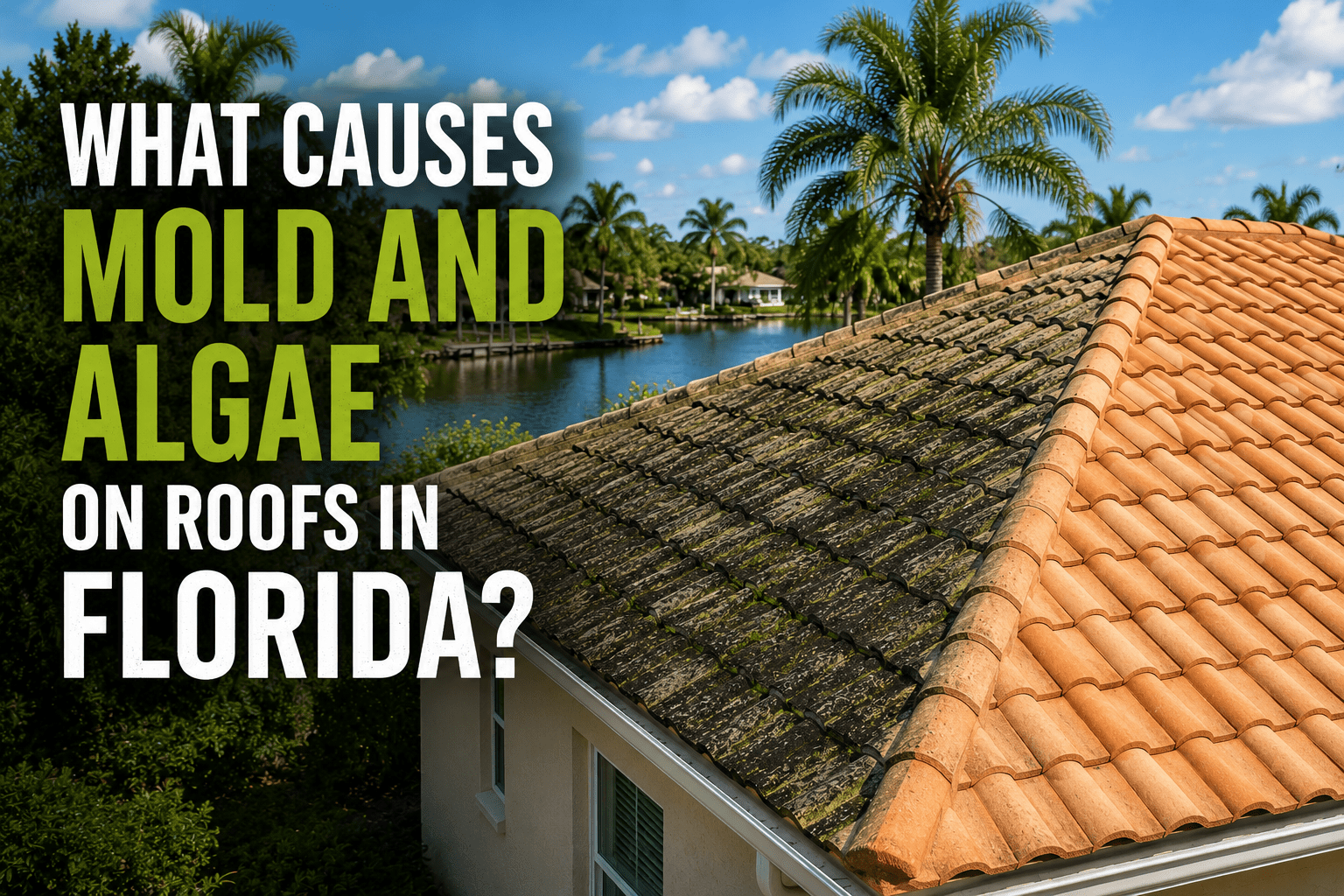
If you live in Miami or anywhere in South Florida, you’ve probably looked up at your roof at some point and noticed dark streaks, green patches, or black stains spreading across your tiles. You’re not alone, this is one of the most common concerns we hear from homeowners every single week.
Let me break down exactly what’s causing that growth on your roof, why Florida makes it so much worse than other states, and what you can do about it.
Florida’s Climate Is a Breeding Ground for Roof Growth
There’s no sugar-coating it South Florida’s weather is basically paradise for mold, algae, and moss. We’re talking about a combination of year-round heat, 70–90% humidity, and a rainy season that dumps inches of water on your roof every week from May through October.
For organic growth like algae and mold, that’s the perfect storm. Warm, wet surfaces that don’t fully dry out? That’s exactly what they need to take hold and spread.
The Three Main Culprits
- Gloeocapsa Magma (Black Algae)
That dark, almost tar-like streaking you see running down your roof tiles? That’s usually Gloeocapsa Magma a type of blue-green algae that’s incredibly common in humid climates. It creates a dark outer shell to protect itself from UV rays, which is why it looks so dark and stubborn.
It spreads through airborne spores, which means your neighbor’s roof can literally seed your roof. Once it grabs hold, it feeds off the limestone filler used in asphalt and concrete tiles.
- Moss
Moss is a plant, not an algae, and it holds moisture directly against your roof surface. In Florida, you’ll typically see it more on shaded areas of the roof, under trees or on the north-facing slope. It looks fuzzy and green, and it can actually lift tiles over time as the root system grows.
- Mold and Mildew
Black or gray mold growth is common on flat or low-slope roofs where water tends to sit after a storm. Mildew tends to appear as powdery white or light-colored patches. Both are signs of consistent moisture that isn’t properly draining or evaporating.
Why Does It Spread So Fast Here?
The answer really comes down to three factors: humidity, shade, and debris. Leaves, dirt, and organic material that pile up on your roof create the perfect food source and moisture trap for growth. And once it starts, it doesn’t stop on its own it spreads.
Most Florida homeowners don’t realize their roof has a problem until they look up one day and it’s already covering a significant portion of the surface. That’s because the growth starts small a few spores, a tiny patch and then accelerates as the colony expands.
Does It Actually Damage Your Roof?
Yes, it does and this is something I can’t stress enough after over 30 years of cleaning roofs across Miami-Dade.
Algae eats away at the protective granules on asphalt shingles. Moss roots get under tile edges and push them up, allowing water underneath. Mold deteriorates the underlying wood or substrate. Over time, what started as a cosmetic issue can lead to leaks, structural rot, and expensive roof repairs or even early replacement.
A roof that should last 25–30 years can have its lifespan shortened by years if organic growth is left untreated.
Can You Prevent It?
Completely preventing it in a Florida climate is nearly impossible the conditions here are just too favorable for growth. But you can significantly slow it down:
- Trim trees that overhang your roof shade and debris are the two biggest accelerators
- Keep gutters clean so water flows away from the roof properly
- Schedule a professional soft wash cleaning every 1–2 years
- Ask your cleaner about mildew cide solutions that create a protective barrier after cleaning
Why Soft Washing Is the Right Solution
A lot of homeowners try to pressure wash their own roofs, and I completely understand the instinct. But high-pressure water on Florida tile or shingles can cause real damage cracking tiles, stripping granules, or forcing water under your tiles.
Soft washing uses a low-pressure application of a properly diluted cleaning solution that kills the algae, mold, and mildew at the root level. Then we rinse it away. The result lasts longer than pressure washing because you’re treating the actual biological growth, not just blasting it off the surface temporarily.
We also use a mildew cide treatment that keeps growth from coming back as quickly which saves you money in the long run.
When Should You Call a Professional?
Honestly? As soon as you notice growth. The earlier you catch it, the easier and cheaper it is to treat. If you can already see dark streaking or visible patches from the ground, the growth has been there for a while.
Our company Kleanway Cleaning Services, we’ve been cleaning Miami roofs since 1990. We know exactly what solutions work on South Florida roofs, which surfaces can handle what pressure, and how to protect your landscaping and home exterior during the process.
Frequently Asked Questions
Q: Is the black streaking on my roof actually algae?
Yes, in almost every case in Florida, those dark streaks are Gloeocapsa Magma algae. It’s extremely common here due to the humidity and heat. It’s not permanent and can be removed with professional soft washing.
Q: Will the algae come back after cleaning?
It can, especially in Florida’s climate. Most professional cleanings include a mildew cide treatment that significantly slows regrowth. Scheduling a cleaning every 1–2 years is the most effective way to stay ahead of it.
Q: Can I use bleach to clean my roof myself?
DIY bleach applications can work but carry risks, improper dilutions can damage tiles or kill surrounding vegetation. Professional cleaners use properly balanced solutions and have the equipment to apply them safely.
Q: Does algae on the roof affect my energy bill?
Yes. Dark algae absorbs more heat, which can raise the temperature of your attic and increase cooling costs. This is particularly relevant in South Florida where air conditioning runs year-round.
Q: How do I know if I need soft washing or roof replacement?
If the underlying structure is intact and the damage is purely biological growth, soft washing will restore your roof’s appearance. If you’re seeing broken tiles, sagging, or interior leaks, consult a roofing contractor. We’re happy to give you our honest assessment when we visit.
Ready to find out what’s actually going on with your roof? Give us a call at (305) 247-3532 or reach out online for a free estimate. We’ll take a look and tell you exactly what we’re dealing with no pressure, no surprises.
I’m Tino, the founder and owner of Kleanway Cleaning Services. Me and my team have been pressure cleaning homes and businesses across Miami-Dade since 1990 that’s over 30 years of working on time, doing the right methods including soft-wash and using the advance equipment.
Based in Homestead, FL, I personally lead my crew on every project, from roof soft washing and driveway cleaning to gutters, windows, and commercial properties. Kleanway is fully licensed, insured, and proud to carry an A+ BBB rating.
South Florida’s heat, humidity, and mold can be brutal on any property. My job is making sure your exterior stays clean, protected, and looking its best every time.
